

If you’ve ever ordered custom antibodies for biotech research, you know the drill: submit your target, wait 6-8 months, cross your fingers, and hope they actually work when they arrive. And far too often, they don’t.
The problems with traditional antibody generation have been an open secret in the life sciences community for years. A recent Nature article (PMID: 39506148) highlighted the growing antibody reproducibility crisis, emphasizing how poorly characterized commercial antibodies continue to undermine experimental reliability. These failures lead to wasted resources, delayed discovery, and frustration across biotech and academic research labs.
At Alces Bioworks, we’re taking a fundamentally different approach. Instead of relying on animal immunization and hoping for the best, we use generative AI and computational protein design to create next-generation AI-designed affinity reagents, called Alceins™. The result? Custom protein binders delivered in 6-8 weeks with predictable performance and known molecular structures.
The Problem with Traditional Antibodies
Let’s be honest about what’s broken: Traditional antibody development takes many months, delivers reagents with unknown structures and unpredictable binding properties, and often simply doesn’t work. Off-the-shelf commercial antibodies aren’t much better; batch variability, discontinued products, and poor reproducibility are well-documented problems that waste researchers’ time and money.
For techniques like immunofluorescence, western blot, immunoprecipitation, ELISA, and immunohistochemistry, the everyday workhorses of life sciences research, this uncertainty is more than frustrating. It’s a barrier to progress.
A Better Way: Computational Protein Design Meets Affinity Reagents
What if you could design your affinity reagent with the same precision as you design a primer or a cloning strategy? What if you knew its structure before you ever ordered it? What if you could have it in your hands in weeks, not months?
That’s the promise of Alceins™.
Our approach leverages the explosion of innovation in computational protein design. The field is evolving at breakneck speed; new tools like AlphaFold, message-passing neural networks, diffusion models, and advanced machine learning architectures are constantly emerging. At Alces Bioworks, we’ve built our proprietary platform to harness these cutting-edge technologies for one specific purpose: creating superior affinity reagents tailored to your target.
The Alces Workflow
Here’s how it works
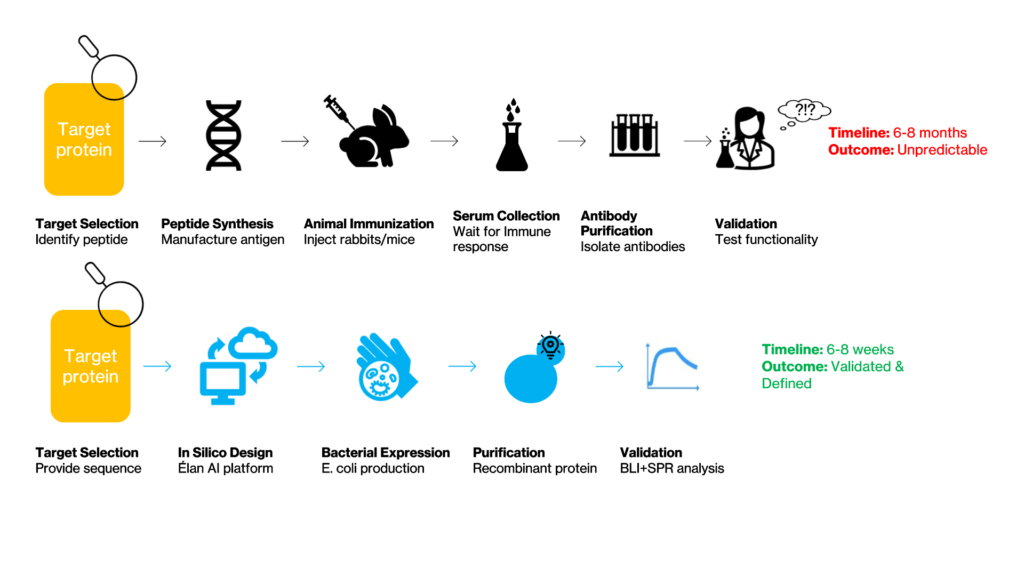
Step 1: You provide your target. We need the amino acid sequence of your protein of interest. If you have additional information, like specific epitopes, post-translational modifications, or structural data, even better. But the sequence is all we need to get started.
Step 2: We design computationally. Using Élan, our computational protein design platform, we perform structure-guided design against your target. This isn’t trial and error, it’s precision engineering. We’re designing proteins that will bind your target with high specificity, and we know their structures before we ever make them.
Step 3: We produce in bacteria. No animals required. We express Alceins™ in E. coli, enabling rapid, scalable, and cost-effective production. This also means we can easily incorporate modular tags, His-tag, FLAG, HA, Myc, AviTag, or custom options, to suit your downstream applications.
Step 4: We validate rigorously. Every Alcein™ goes through a two-stage validation process. First, biolayer interferometry (BLI) screens candidates rapidly to identify binders. Then, surface plasmon resonance (SPR) provides precise affinity measurements, giving you actual KD values you can trust. (Read our previous blog to learn more about these techniques)
Proof of Concept: Real Results from Real Projects
Let’s look at a recent case study that demonstrates what you can expect when you work with Alces Bioworks – from design to validated binders with quantified performance metrics.
We were approached with a target protein for Alcein™ design. Using our Élan platform, we designed seven Alcein™ candidates tailored to this target. We synthesized the sequences, expressed them, and purified them for testing.
The results? All seven candidates showed binding activity in our initial BLI screen. Three stood out as particularly promising.
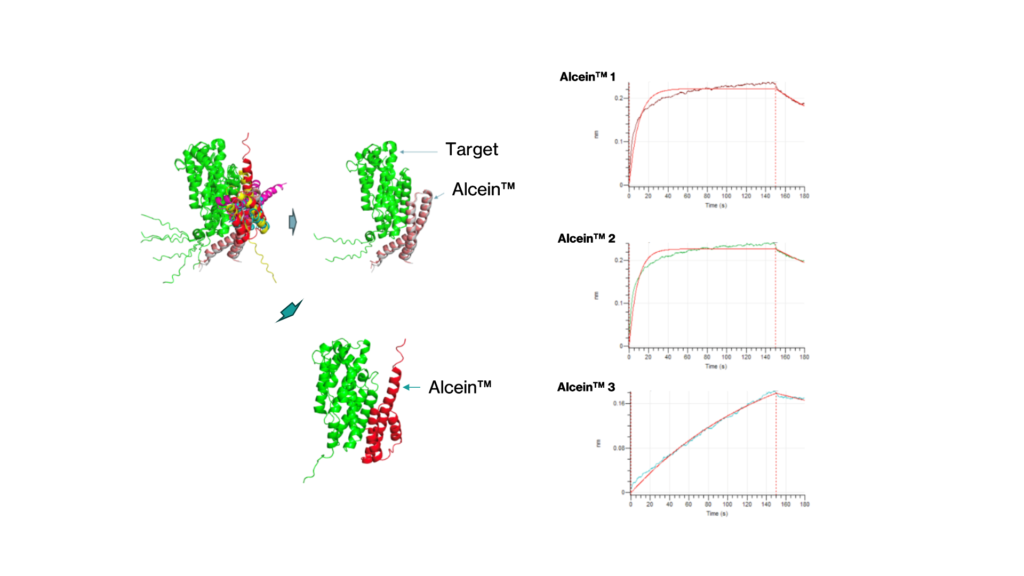
Alceins (red), as well as BLI binding curves for the three top candidates.
We then moved these top candidates to SPR for quantitative characterization. One Alcein™ in particular demonstrated exceptional performance – an affinity of 71 nM with distinct kinetic properties, including a notably slow off-rate that makes it ideal for applications requiring stable binding.
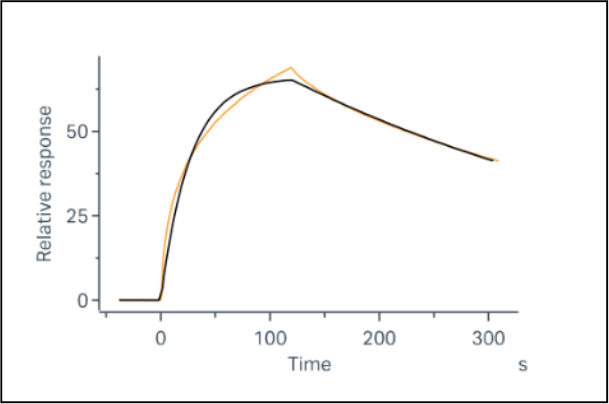
Think about what this means: from design to validated, high-affinity binder in a matter of weeks, with seven functional candidates and multiple options for optimization.
The Science Is Proven
Can small protein binders like Alceins™ actually work in standard assays? Absolutely. A study published in eLife (Tiede et al., PMID: 28654419) showed that they perform just as well as antibodies across all the standard applications: western blots, immunoprecipitation, immunohistochemistry, and even super-resolution microscopy. The engineered proteins matched the staining patterns of commercial antibodies in tissue samples, with the bonus of known structure and consistent production. It’s validation that rational design can deliver the same results as traditional methods, just faster and more reliably.
The Future of Affinity Reagents
The field of computational protein design is experiencing a renaissance. Advances in AI protein design, structure prediction, and generative machine learning models are accelerating at an unprecedented pace. The tools that were cutting-edge last year are being superseded by more powerful approaches this year.
At Alces Bioworks, we’re not just keeping pace. We are actively integrating the latest advances in generative AI, structure-based modeling, and protein engineering into our platform to continuously improve the speed, reliability, and performance of our AI-designed affinity reagents.
For researchers tired of waiting months for antibodies that might not work, biotech companies seeking reliable affinity reagents for R&D or manufacturing, and for teams working with challenging or non-immunogenic targets, Alceins™ offer a proven alternative to traditional antibodies.
The question isn’t whether computational protein design will replace traditional antibody generation. It’s how quickly the transition will happen.
Ready to experience the difference? Contact us at info@alcesbioworks.com to discuss your project.
Because your research shouldn’t have to wait for outdated technology to catch up.
FAQs
Traditional custom antibody generation typically takes 6–8 months because it relies on animal immunization, hybridoma screening, and iterative validation. This process is time-consuming and often produces antibodies with unknown structures and unpredictable binding properties. In contrast, AI-designed affinity reagents like Alceins™ can be delivered in 6–8 weeks using our computational protein design pipeline and efficient expression systems.
The antibody reproducibility crisis refers to widespread concerns that many commercial antibodies fail to perform as advertised, leading to unreliable experimental results. A study published in Nature (PMID: 39506148) highlighted ongoing quality control issues affecting research reproducibility in biotech and academic labs. Problems include batch variability, discontinued reagents, poor specificity, and inconsistent validation, resulting in wasted time and resources across life sciences research.
Alceins™ are AI-designed affinity reagents created using generative AI and computational protein design instead of animal immunization. Built on the proprietary Élan platform at Alces Bioworks, Alceins™ are engineered with known molecular structures, predictable binding kinetics, and validated KD values. They are expressed efficiently, allowing rapid, scalable production and easy incorporation of affinity tags such as His-tag, FLAG, or HA. The result is faster delivery, structural transparency, and improved reproducibility.
Engineered protein binders similar to Alceins™ have been shown to perform comparably to antibodies in applications such as western blot, immunoprecipitation, immunohistochemistry, and super-resolution microscopy. A peer-reviewed study published in eLife (Tiede et al., PMID: 28654419) demonstrated equivalent staining patterns and assay performance, with the added benefits of known structure and consistent recombinant production.